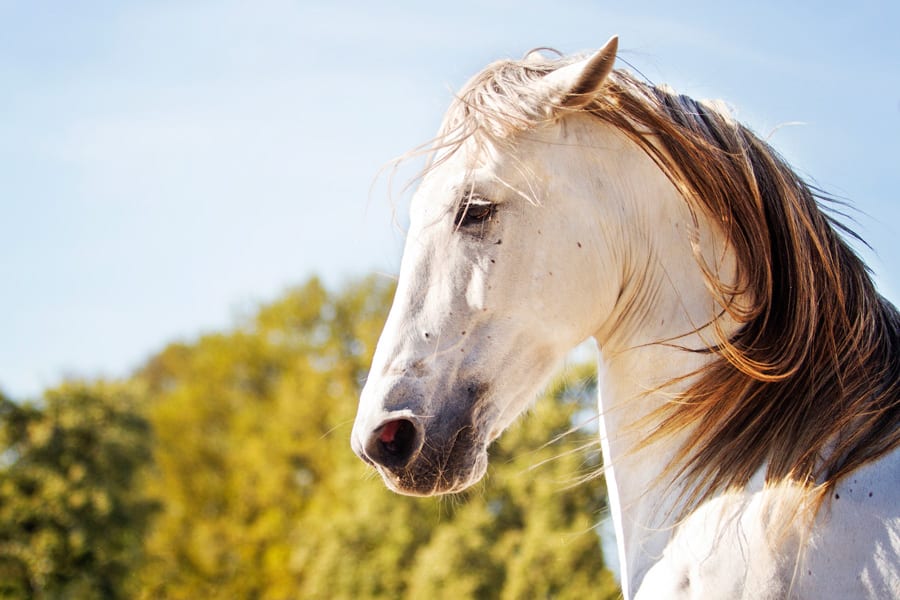
Your horse’s behaviour is not proof that he is bad, stubborn or disrespectful. It is information about what he is feeling, perceiving, expecting, learning, or physically experiencing. When you stop fighting only what you can see and begin looking for the reason beneath it, lasting change becomes possible.
You did not get a horse because you wanted a problem to solve
You got a horse because you wanted a connection.
You imagined the quiet moments as much as the exciting ones. Walking toward the field and seeing him lift his head when he heard your voice. Loading onto the trailer without a fight. Riding away from the yard without feeling your whole body tighten. Knowing that when something frightened him, he would still be able to hear you.
You wanted to feel safe with your horse. And you wanted your horse to feel safe with you.
So when he begins to pull away, walk into your space, refuse to load into the trailer, bite while being girthed, spin on the trail, rush back toward the other horses or refuse to stand still at the mounting block, it does not feel like a small training problem.
It feels personal.
You begin to wonder whether he trusts you. Whether he respects you. Whether you have failed him. You try to be softer, then firmer. You watch another video, change your technique and promise yourself that this time you will not let him win. But the more urgently you try to fix the behaviour, the more distant the relationship you wanted in the first place can begin to feel.
This is the moment when a different question can change everything.
When a label replaces a question
A horse that bites is called disrespectful. A horse that refuses to load into the trailer is called stubborn. A horse that spooks is called dramatic. A horse that will not stand at the mounting block is called difficult. A horse that bucks when asked to canter is accused of testing the rider.
These words may describe how the situation feels to us. But they do not explain what is happening for the horse.
They do not tell us whether the horse is in pain. Whether he is afraid of entering a dark, enclosed trailer. Whether the last release taught him to pull backwards. Whether the pressure from the rider’s leg and the restriction from the rein are asking for two opposite answers. Whether he has learned that rearing makes the demand disappear. Or whether he has repeated the same response so many times that it has become the only answer he knows.
The label closes the investigation at the exact moment curiosity is needed most.
Many horse behaviour problems become easier to address only after we stop treating the label as the cause. The moment we decide that the horse is the problem, our attention moves toward stopping, correcting, or overpowering the visible response. We may succeed in suppressing it for a while. But if the reason beneath it remains — pain, fear, confusion, conflict, unmet needs, an accidental reinforcement history, or a combination of several factors — the problem has not been resolved. It has simply become quieter, moved somewhere else or returned when the pressure became greater.
The more useful question is not, ‘How do I make this behaviour stop?’ It is, ‘What is this behaviour telling me, and what must change for my horse to respond differently?’
This reframe — from judging behaviour to reading it — is the foundation the whole MBH approach is built on. When you begin to understand what your horse’s behaviour is communicating, you can respond to what is actually causing the behaviour rather than simply trying to make it stop.
Behaviour is an outcome, not a personality flaw
Behaviour never appears out of nowhere. It comes from the horse’s nervous system, body, emotions, past experiences, surroundings and everything that has happened in the moments before it. By the time you see the bite, buck, rear or refusal, a sequence of events has already led to that response.
This does not mean every behaviour should be permitted. A horse cannot be allowed to bite you because he feels frustrated. He cannot run through your space because he is frightened. Biting, striking, barging, rearing, bolting or pulling away can be dangerous and require an immediate, clear response.
But a boundary answers only one question: what cannot happen here?
It does not, by itself, explain why the behaviour developed or teach the horse what he can do instead.
An evidence-informed approach separates two tasks that are often confused:
- Keep everyone safe in the moment, with clear positioning, good timing and firm boundaries when they are needed.
- Then look deeper and change whatever keeps creating the behaviour.
Good horsemanship needs both. Compassion without clarity can leave people unsafe. Control without understanding can escalate fear and conflict.
Understanding your horse does not mean becoming unclear or allowing dangerous behaviour, just as setting a boundary does not mean you stop listening to what his behaviour is telling you. Your horse can have a valid reason for his response and still need you to say, clearly, “You cannot run through me.” Good horsemanship holds both truths at once.
The goal is not to choose between kindness and leadership. It is to become calm enough to notice what is happening, clear enough to protect a boundary and flexible enough to change the plan when your horse shows you that something is not working.
The five questions behind almost every ‘problem’ behaviour
1. Could the horse be in pain or physical discomfort?
Pain should be one of your first questions when a horse’s behaviour suddenly changes, appears during one specific task or becomes much stronger than usual. A horse cannot tell you, ‘My back hurts when you sit here.’ He can only change the way he moves, stands, looks or reacts.
Researchers have identified 24 ridden behaviours that are often seen in horses with muscle or joint pain. This is called the Ridden Horse Pain Ethogram. One sign on its own does not prove that a horse is in pain. A tail swish is still just a tail swish until you look at the rest of the horse and the situation. But when several signs repeatedly appear together, the pattern matters. In one study, these signs became less frequent after the painful area was numbed. In plain language: some behaviour riders call laziness, resistance or a bad attitude may actually be a horse trying to protect a painful body (Dyson et al., 2023).
Pain-related behaviour may include repeated ear positions, changes in eye expression, an intense stare, opening the mouth, head tilting, abnormal head carriage, reluctance to move forward, repeated changes of gait, stumbling, tail swishing, bucking, rearing, or sudden evasions. On the ground, warning signs may appear as girthiness, difficulty lifting a foot, aggression during grooming, resistance to bending, reluctance to load, or a previously cooperative horse becoming defensive.
Here is the simple rule: do not use more training to prove that your horse is not in pain. If the behaviour is new, stronger on one side, linked to one movement or getting worse, pause and look further. Changes in gait, appetite, weight, posture, performance, sensitivity to touch, reaction to tack or recovery after work all matter. A veterinarian should be your first call when pain is a real possibility. Saddle fit, teeth, feet, gut health, reproductive health, eyesight and rehabilitation may also need to be checked, depending on the horse.
This does not mean that every refusal to move forward is caused by pain. It means pain deserves to be ruled out before a horse is repeatedly corrected for a response his body may be producing to protect him.
If your previously willing horse begins pinning his ears when the saddle appears, moving away as you tighten the girth, hollowing his back when you mount, struggling more on one rein, refusing transitions he once offered or bucking at the same point in every ride, do not reduce the whole pattern to a bad attitude. The change itself is information.
2. Is the horse afraid, anxious, or over threshold?
Fear is not disobedience. It is a protective response. A horse may freeze, raise the head, increase muscle tension, scan, snort, hesitate, rush, spin, pull away, rear, or attempt to flee. The visible behaviour differs between individuals and situations; a horse who looks still may not be emotionally settled.
Research also shows that we cannot judge a horse’s emotional state from movement alone. In tests with unfamiliar objects, some horses had a strong rise in heart rate while showing surprisingly little on the outside. So a horse who stands still is not automatically calm. He may be thinking, or he may be frozen. In the same way, a horse who moves his feet is not automatically panicking (Safryghin et al., 2019).
Horse people often say that a horse is ‘over threshold’. It simply means that the situation has become too much for him. He is no longer calmly searching for the answer. His need to protect himself has taken over. At that point, adding more pressure may create more movement, but not more understanding.
Useful learning happens close enough to the challenge for the horse to notice it, but not so deep inside fear that he can only fight, flee or freeze.
Imagine a horse who stops several metres away from the trailer. His neck rises. His breathing changes. His feet become fixed to the ground, while his body is already leaning backwards. If the only thing we notice is that he has not walked forward, we may increase the pressure. But the horse is not experiencing one simple request to move his feet. He may be trying to manage the darkness inside the trailer, the hollow sound beneath him, the separation from other horses, the memory of a previous journey and the pressure now building behind him.
Moving his feet matters. But so does understanding the emotional state in which we are asking him to move them.
The aim is not to wait until the horse feels no uncertainty. Confidence is developed by moving through manageable uncertainty. The skill is recognising the difference between a horse who is thinking his way through a challenge and a horse who has become too overwhelmed to find the response you are asking for.
3. Does the horse understand the cue — and the correct response?
We often assume that a horse knows exactly what we want and has simply decided not to do it. But horses learn from what happens before and after a behaviour. Our cue only gains meaning when we use it consistently.
Take pressure and release. In scientific language, removing pressure after the right response is called negative reinforcement. The word negative means that something is removed; it does not mean cruel or bad. You ask with the rope, leg, rein, body or whip. The moment the horse moves toward the correct answer, the pressure changes or disappears. That release tells him, ‘Yes. That was it.’
If the release comes late, the horse may connect it to the wrong step. If it never comes, he may stop searching for the answer. If your leg says go while your hand says stop, he may become tense, slow, rush, toss his head or show another conflict behaviour. Conflict behaviour is the horse’s way of showing that the situation or signals do not fit together for him. Research links unclear timing and contradictory cues with stress, poorer responses and greater safety risks (McLean & Christensen, 2017; O’Connell et al., 2025).
Before increasing intensity, ask:
- Did I give one clear cue for one clear response?
- Did I release or reward at the exact moment the horse moved toward the answer?
- Could my hands, seat, legs, rope, whip, posture, and direction be saying different things?
- Have I broken the task into steps the horse can physically and emotionally perform?
- Am I testing understanding, or merely testing how much pressure the horse will tolerate?
A stronger cue is not automatically unfair. Sometimes a horse notices the light cue but does not respond. A clear increase, followed by an immediate release, can teach him that the first, lighter cue matters. What makes pressure unfair is not only how strong it is. It is pressure without clarity, timing or release — or pressure that ignores what the horse can physically and emotionally manage.
This is why learning a scale of pressure is not the same as learning to use more pressure. It is learning how little is enough, when an increase is necessary, when to release and when the horse’s response is telling you that the question itself needs to change.
4. What has this behaviour achieved in the past?
A behaviour can begin for one reason and continue for another. A horse may first pull away because he is frightened, then learn that pulling creates distance and ends the demand. A horse may paw because he is frustrated, then learn that pawing makes a person deliver food or attention. A horse may refuse the mounting block because of discomfort, then retain the avoidance pattern after the original pain has improved.
This is why asking, ‘Is it pain or is it behaviour?’ is often too simple. Pain can start the behaviour. Fear can strengthen it. And if the behaviour repeatedly produces a useful outcome for the horse, he may learn to repeat it. Even after the body feels better, the horse may still expect the old pain and repeat the response that protected him before. In that case, resolving the physical cause may not be enough — the horse may also need careful retraining. But retraining alone will not be fair or effective if the pain is still there.
Look for the consequence that follows the behaviour. Does the task stop? Does pressure disappear? Does the horse gain distance, return to the herd, gain access to food, avoid touch, or make the human change position? Consequences reveal why a behaviour may be strengthening even when nobody intended to teach it.
Consider the horse who pulls back when tied. The first time may have begun with panic. The rope tightened, the pressure frightened him and he fought until something broke or a person released him. From the horse’s perspective, pulling harder created freedom. The next time, the response may appear sooner and become stronger — not because the horse is plotting against the handler, but because the consequence taught him that this behaviour works.
Or consider the horse who swings his hindquarters away every time you place your foot in the stirrup. If you repeatedly step down, reposition him and then abandon the ride, moving away from the mounting block may become an effective way to end the task. That learned pattern can exist alongside saddle discomfort, imbalance, anxiety or an inconsistent mounting routine. Understanding the learning history does not deny the emotional or physical cause. It helps us understand why the behaviour may continue even when the original cause is no longer the whole explanation.
5. How might the horse's daily life be influencing his behaviour?
What happens in a training session is connected to the rest of the horse’s life. Turnout, social contact, forage availability, rest, previous handling, chronic stress, transport, housing, and the predictability of daily life can influence emotional state and behaviour. A horse whose basic needs are not being met may have much less room for another difficult request.
A large review of the human-horse relationship reached a very practical conclusion: the relationship is built through management, training and all the small interactions that happen every day. It also warned that no step-by-step recipe can replace the ability to observe the individual horse and adapt to the situation in front of you (Hausberger et al., 2008).
This matters because two horses can display the same behaviour for different reasons. One horse may rush into a trailer because he is anxious to return to companions. Another may rush because release has always occurred after acceleration. A third may struggle because balance, footing, darkness, vision, or physical discomfort makes the task difficult. The behaviour is the starting point of the investigation, not the conclusion.
It also means the same horse may need a different answer on a different day. The cue that was clear in the arena may become harder to follow beside a busy road. The horse who can stand quietly at the mounting block after turnout may struggle after several days in a stable. The horse who loads at home may rush backwards in an unfamiliar place when the other horses have already left.
Consistency does not mean repeating the same action regardless of the result. It means keeping your principles consistent while adapting your decisions to the horse and situation in front of you.
Your horse is reading you, too
Communication moves both ways. Your horse is learning about you while you are learning about him. Studies show that horses can tell the difference between positive and negative human facial expressions. They can also connect information from a person’s face and voice, and remember the expression a particular person showed before (Smith et al., 2016; Proops et al., 2018).
This does not mean your horse can read every private thought. It does not prove that he magically absorbs your energy. And it certainly does not mean that every difficult reaction is your fault.
But your state does change your body. When you become nervous, you may stop breathing freely. Your shoulders tighten. Your hand closes around the rope. You lean forward. Your timing becomes faster or later. You hesitate, then suddenly use too much pressure. These are real changes your horse can see and feel.
Research into human and horse stress is more complicated than the popular statement that your heart rate simply becomes your horse’s heart rate. Early studies suggest that horses are sensitive to changes in the interaction, but they do not support blaming every horse reaction on the human nervous system (Merkies et al., 2014).
Your horse may not know the story running through your mind. But he can feel the hand that became tighter. He can see the body that stopped breathing and leaned forward. He can experience the cue that arrived too quickly, the release that came too late and the hesitation that disappeared the moment he took control of the direction.
Emotional regulation is therefore not about pretending to feel calm. It is not about blaming yourself for every reaction your horse has. And it does not mean you must remove all emotion before you are worthy of leading him.
It means becoming aware of what your body is communicating before you act. Noticing when you have become hurried, rigid, hesitant, frustrated or disconnected. Giving yourself enough space to return to the present moment, so that your next decision comes from awareness rather than reaction.
Your horse does not need you to be perfect. He needs your signals to become clearer than your tension.
Leadership without the dominance myth
The word leadership is only useful when we explain what we mean by it. Research does not support the idea that you must become the ‘alpha horse’ or win a place above your horse in his herd ranking. You are not a horse, and your horse does not need you to pretend to be one. His response to you is better explained by what he has learned, what he expects, what he feels, what motivates him and what happens after each response (Hartmann et al., 2017).
That does not make leadership irrelevant. It makes the definition more precise. In Mind Body Horsemanship, leadership is not about dominance or a claim to biological rank. It is the human responsibility to provide:
- calm direction rather than emotional escalation;
- clear boundaries rather than personal punishment;
- consistent cues and timely release;
- body awareness and purposeful positioning;
- a level of pressure appropriate to the horse, task, and moment;
- the judgement to investigate pain, fear, confusion, and welfare before labelling resistance;
- and the flexibility to change the plan when the horse's response provides new information.
In other words, leadership is responsibility. It is not power for the sake of power. It asks more from the person, not less.
It also avoids the opposite mistake: removing every request the moment the horse feels uncomfortable. A horse can be unsure and still need a clear direction. He can be frightened and still be asked not to run through your space. He can need a boundary and understanding at the same time.
The skill lies in understanding what the behaviour means, knowing how to respond safely in the moment, and recognising what needs to be taught or changed next.
What leadership looks like in the moment
Leadership is easy to describe when everything is going well.
It becomes visible when your horse says no.
When he plants his feet at the entrance to the trailer. When he pulls toward the gate. When he walks into your space because another horse is leaving. When he moves with his shoulder toward you instead of stepping backwards. When he raises his head, braces his neck and stops being able to hear the quiet cue you started with.
In those moments, leadership is not about proving that you are stronger. The horse already knows you are not.
It is your ability to remain mentally present while reading what is happening in his body. To recognise whether he needs a clearer boundary, a better-timed release, a simpler question, more preparation, a different position or a pause long enough for him to find his balance again.
Sometimes leadership means lowering the pressure because the horse is trying and needs time to organise the answer. Sometimes it means increasing it because the horse has learned that the first cue can safely be ignored. Sometimes it means ending the session and calling the veterinarian. And sometimes it means calmly staying with the question after both you and the horse would prefer to walk away from it.
The difference is not found in a single technique. It is found in the quality of the decision.
That is why MBH does not begin with the question, ‘Which method should I use?’ It begins with your ability to observe, understand and choose deliberately.
How to respond in practice: a seven-step MBH framework
- Secure the situation. Create enough distance, positioning, and control to keep horse and human safe. Do not attempt a deep training analysis while you are being pulled, crowded, kicked at, or placed in danger.
- Describe before interpreting. Put the label aside for a moment. Instead of “He is disrespectful,” say: “When I ask him to step back from his feed bucket, he raises his neck, moves his shoulder into me, and bites toward my arm.” Facts help you see patterns that judgement hides.
- Check for pain and physical limitation. Ask whether the behaviour is new, stronger on one side, linked to touch, tack, a certain movement or one part of the session. Get professional help when pain may be involved. A sudden or severe change needs veterinary attention.
- Identify the emotion and threshold. Look at the whole horse and at what happened before the response. Can he still notice you, think and answer a simple cue he knows? Or has the situation become too much for him?
- Check your own communication. Ask for one clear response with one clear cue. Remove unnecessary noise. Make the right answer easy to find, then release at the first honest try.
- Change one variable at a time. Adjust distance, duration, approach, footing, companion proximity, equipment, handler position, or task difficulty. When everything changes at once, you cannot learn which variable mattered.
- Look for a better pattern, not one perfect moment. Real progress means your horse recovers sooner, needs less pressure, stays more organised and can find the same answer in slightly different places. One repetition after the horse is exhausted is not proof that he understood.
Five common examples
The horse who will not load
He walks toward the trailer, then stops. You ask again. His neck rises, his feet begin moving sideways and every attempt to send him forward seems to push another part of his body away. If the pressure continues, he may rush backwards, pull the rope through your hands or rear.
From the outside, the problem appears simple: the horse will not walk onto the trailer.
But refusal is not the diagnosis. Possible contributors include separation distress, a previous frightening journey, balance or footing difficulty, pain, visual contrast, the hollow sound of the ramp, rushing caused by earlier pressure, or a learned pattern in which pulling backwards or rearing makes people retreat.
This is why trailer loading cannot be reduced to standing behind the horse and creating more forward pressure. Before he can confidently load, he may need to understand how to follow a light feel, move the shoulders without escaping through them, regulate one forward and one backward step, wait without leaving, recover after uncertainty and stay connected to the handler while the environment becomes more difficult.
The trailer reveals the missing pieces. It rarely creates all of them.
The horse who bites
Perhaps he reaches toward you when you tighten the girth. Perhaps his ears disappear backwards when you touch one particular area. Or perhaps he searches your pockets, pushes into you and bites when food does not arrive quickly enough.
All three horses bite. They may not be communicating the same thing.
Biting may relate to pain, guarding feed or space, frustration, fear of touch, sexual or social behaviour, inconsistent boundaries, accidental food reinforcement or a history of people ignoring quieter signals until the horse learned he had to become louder.
Safety requires stopping the horse’s access to your body and re-establishing personal space. But lasting change requires more. When exactly does the bite appear? What does the horse do in the seconds before it? What happens immediately afterwards? Does the behaviour occur around food, touch, equipment, movement or one specific person? Did the horse first turn his head, tighten his muzzle or move away before he finally bit?
The clearer you become about the sequence, the less likely you are to correct the final behaviour while continuing to miss everything that led to it.
The horse who is ‘lazy’ or behind the leg
You close your leg and nothing happens. You squeeze harder. Then you kick. For a few strides the horse moves forward, but soon you are carrying him again — asking with every step and wondering why he has become so unresponsive.
Reduced forward response can reflect pain, fatigue, fitness, confusion, learned habituation to constant leg pressure, conflicting rein and leg cues, fear of making a mistake or a rider who never truly releases the aid.
Escalating the cue may briefly increase speed, but it can further dull the horse if the pressure remains once he moves. From the horse’s perspective, there is no clear difference between the moment before the right answer and the moment after it. The leg becomes background noise rather than useful information.
A clearer system teaches that the light cue matters, a stronger cue follows only when necessary and all pressure changes the moment the intended response occurs. The purpose of the stronger cue is not to make the horse depend on stronger pressure. It is to make the light cue meaningful again.
The horse who walks away when you try to catch him
You enter the field with the halter. Your horse looks at you, waits until you are almost close enough, then quietly turns and walks away. You follow. He walks away again. After twenty minutes, both of you are frustrated and the whole interaction has become a chase.
It is easy to say that he does not want to work or that he has no respect. But look at the larger pattern. Does being caught always mean leaving his friends, hard work, discomfort or a rushed session? Do you approach directly toward his head with your eyes and shoulders fixed on him? Does he turn away, and do you immediately remove pressure by stopping? Has walking away become the easiest way to control your approach?
Catching begins long before your hand touches the halter. It lives in the way you approach, notice his first response, change your position, reward a small turn toward you and teach him that connection does not always predict something unpleasant. The goal is not to trap him. It is to make staying connected a clear and worthwhile answer.
The horse who moves away from the mounting block
You line him up. The moment you put weight in the stirrup, his hindquarters swing away. You bring him back, and he does it again. Soon you are pulling his head toward you, trying to block his body with the mounting block and wondering why he will not simply stand still.
Before calling it a manners problem, check the body and the history. Does the saddle fit? Does he brace when you touch his back? Is the rider pulling the saddle sideways while mounting? Does he understand how to move one part of his body without moving the rest? Has stepping away repeatedly made the rider stop trying?
Standing at the mounting block is not one skill. It includes approaching in balance, placing the shoulders and hindquarters, waiting, accepting movement above the back, taking the rider’s weight and remaining emotionally present. When you teach those pieces separately, you stop repeating the final struggle and begin showing the horse exactly what he can do instead.
Before your next session, ask yourself
You do not need to diagnose your horse from a checklist. These questions are simply a way to slow the moment down long enough to see what frustration often hides:
- What did my horse do immediately before the behaviour I am calling the problem?
- Is this response new, stronger than usual, one-sided or linked to touch, tack or a particular movement?
- What might my horse be trying to move toward, move away from, stop or make happen?
- What did my horse learn from the consequence that followed the last repetition?
- Was my cue clear enough that I could describe the exact response I wanted?
- Did my release make the correct moment unmistakable?
- Was my horse uncertain but still thinking, or had he already moved into a survival response?
- What was my own body doing — breathing, bracing, leaning, gripping, hesitating or rushing?
- Does safety require a firmer boundary right now, while the cause is investigated separately?
- What is the smallest part of this task my horse and I can perform with clarity today?
The purpose of these questions is not to make you overanalyse every step. It is to help you replace automatic correction with a more accurate decision.
Because the quality of your horse’s answer will always be shaped by the quality of the question he believes you asked.
What this perspective does — and does not — mean
Seeing behaviour as information does not mean:
- allowing dangerous behaviour because the horse has a reason;
- assuming every problem is trauma;
- treating every ear movement as a diagnosis;
- avoiding pressure altogether;
- or believing that perfect calmness in the human will automatically fix the horse.
It means refusing to confuse suppression with resolution. It means using pressure with timing and release rather than emotion. It means recognising that a horse can be accountable to a clear boundary while the human remains accountable for communication, welfare, training design and safety.
When behaviour becomes too complex or dangerous to address safely on your own, that responsibility also includes knowing when to seek individual professional support.
The shift that changes the relationship
When behaviour is treated as the enemy, every interaction can become a contest. The horse resists. The human increases pressure. The horse protects himself more strongly. The human concludes that stronger correction was necessary. Both leave the interaction more certain that the other cannot be trusted.
But when behaviour is treated as information, the same moment becomes feedback.
You can still stop dangerous behaviour. You can still ask your horse to stay out of your space, follow your direction and respond when a response is necessary. But you are no longer reacting as if his behaviour were a personal insult. You are looking at what he understands, what his body can do, what he can cope with, what your own body is saying and what he learns from each repetition.
And slowly, the relationship begins to feel different.
Not because your horse never becomes afraid. Not because he agrees with every request. And not because you found one technique that works in every situation.
It changes because you are no longer meeting every difficult behaviour as proof that something is wrong with your horse — or with you.
You begin to see more. You react less. Your boundaries become clearer because they are no longer driven by anger. Your release becomes easier for the horse to understand. You begin to notice the smaller moments before the horse has to become louder. And when the plan is not working, you have enough awareness to change it without losing your direction.
That is the deeper purpose of horsemanship: not to create a horse who never says no, but to become a person capable of understanding the message, protecting the relationship and guiding the horse toward a safer answer.
Because your horse’s behaviour is not standing in the way of your leadership.
It is developing it.
If your goal isn’t simply better behaviour…
…but to understand what creates it in the first place, the MBH Academy will guide you beyond isolated techniques. You will learn how to observe the horse in front of you, understand what his behaviour is communicating, use your body and position deliberately, apply pressure and release with clarity, establish safe boundaries and make thoughtful decisions you can adapt to different horses and situations — both on the ground and under saddle.
Explore MBH Academy →