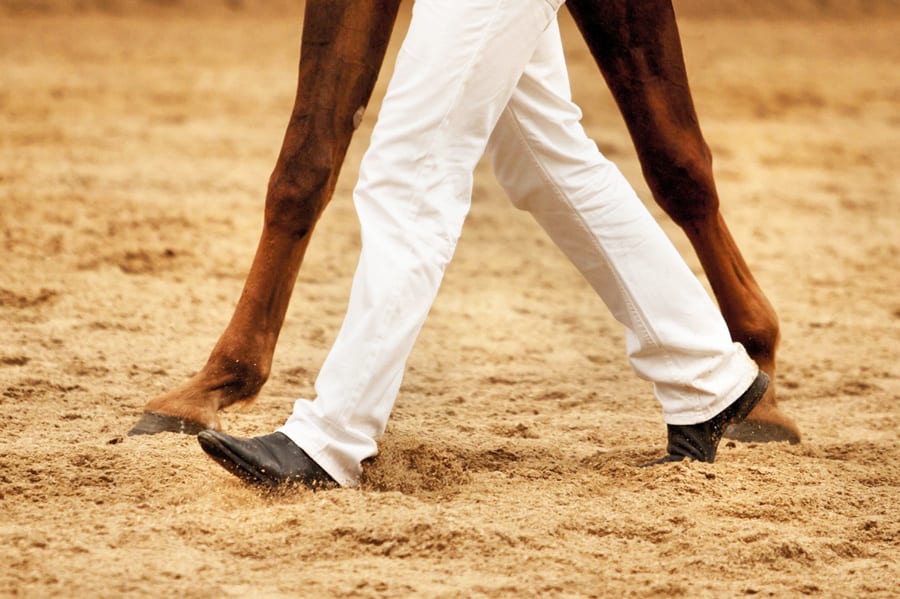
Leadership is not measured by how much control you have over your horse. It is reflected in how clearly you can guide him while remaining aware of what he is feeling, understanding and communicating. A horse can need a boundary without needing to be dominated. He can need you to become clearer without needing you to become harsher.
You wanted a partnership — not a constant fight for control
You did not dream of owning a horse because you wanted someone to overpower.
You wanted a partnership that felt natural — a horse who trusted your guidance, responded willingly and felt like he was with you rather than constantly working against you.
You wanted to walk into the field and have him choose to stay connected. You wanted to lead him past something frightening without being dragged, ride away from the other horses without a battle and ask for a transition without your whole body becoming tense.
You wanted your horse to understand what you were asking of him. And when he was unsure, you wanted him to trust you enough to look to you for direction.
But then real life happens. He pushes into you with his shoulder on the way to the field. He pulls toward the gate. He plants his feet at the trailer. He moves his hindquarters away from the mounting block. He ignores the light cue and responds only when you make it stronger. And suddenly the advice begins:
- You have to show him who is boss.
- Do not let him win.
- Make him respect you.
- He is trying to dominate you.
Perhaps you try it. You make your body bigger. You increase the pressure sooner. You move his feet because someone told you that whoever moves first is lower in the hierarchy. Sometimes the behaviour stops. Sometimes it becomes worse. And sometimes your horse complies, yet you are left wondering whether you have actually built more trust or simply gained more control.
Then another person tells you the opposite: never use pressure, never insist, always wait for consent, reward every correct response with a treat and avoid anything that might make your horse uncomfortable. Be softer. Ask less. Give him more time. If he says no, listen. If he walks away, let him. If he becomes frustrated, lower the expectation.
Now you are caught between two extremes. One tells you that leadership means control. The other can make clear expectations and necessary boundaries feel unkind.
Neither gives you what you actually need: the ability to listen to your horse without becoming unclear, set a boundary without becoming forceful and provide direction without turning every disagreement into a battle you have to win.
That is where a more useful understanding of leadership begins.
The problem with the ‘alpha horse’ story
Horses do form social relationships. They can also have dominance relationships with other horses. If two horses repeatedly compete for the same pile of hay and one usually gives way, we can describe a predictable outcome between those two horses in that particular situation.
But this is not the same as saying one horse controls every movement, always determines where the herd goes or makes every decision for the group. Horse relationships are more flexible than the simple pyramid many of us were taught.
Dominance mainly helps researchers describe which horse is more likely to gain access to a limited resource, such as food, water or space, when another horse wants it too. It does not automatically tell us which horse others choose to follow, who they prefer to stand beside, who helps them feel safe or how every interaction will unfold.
Most importantly, you are not another horse in your horse’s herd. You communicate differently, experience the world differently, have different needs and do not participate in the same social relationships horses have with one another.
Chasing him, moving his feet or forcing him to yield does not turn you into an alpha horse. It teaches him about the consequences of your cues, what happens when you enter his space and what he can expect when he responds.
A major scientific review of dominance and leadership in human-horse interactions concluded that applying horse social rank directly to training is misleading. A horse’s response to a person is better explained through learning, previous experience, motivation, emotion, perception and the immediate situation (Hartmann et al., 2017).
In plain language: your horse is not standing at the trailer ramp trying to establish dominance over you. He may be afraid. He may be confused. He may have learned that pulling backwards ends the pressure. He may be physically uncomfortable. Or he may understand the cue and have learned that the first three requests can safely be ignored.
Those possibilities require different decisions. The word dominance hides those differences behind one convenient story: the horse is simply trying to challenge your authority.
If leadership is not dominance, what is it?
Leadership is not a scientific label for a special rank you achieve over your horse. In Mind Body Horsemanship, leadership means taking responsibility for the guidance you provide and the decisions you make.
It is your ability to understand what is happening, recognise what the moment requires and provide clear direction your horse can understand and respond to.
Sometimes that means making the question smaller. Sometimes it means increasing pressure when the horse does not respond to a familiar cue. Sometimes it means changing your position because your body is blocking the movement you are asking for. Sometimes it means holding a clear boundary even though your horse is emotional. And sometimes it means stopping the session because the behaviour may be connected to pain.
Leadership is not always softer. It is not always firmer. It is accurate.
The question is not, “How do I win this?” It is, “What is happening, how do I keep both of us safe and what does my horse need from me next?”
This is why true leadership asks more of the human than dominance ever could. Dominance gives you one answer: become stronger. Leadership asks you to observe, regulate yourself, understand what your horse is learning, use your body deliberately, protect safety, make thoughtful decisions and change the plan without losing direction. It requires you to become more skilled, not simply more forceful.
The five foundations of true leadership with horses
1. Clarity: can your horse find the answer?
A horse cannot follow an intention that never becomes a clear signal. You may know exactly what you want, but your horse only experiences what your body, rope, rein, leg, seat and timing actually do.
Imagine asking your horse to back up from the ground. You step toward his chest to ask him to move back, but your hand keeps a constant tension on the rope. Your body leans forward, and when he finally shifts his weight back, nothing in your position or the pressure you are using changes. He lifts his head, braces and moves sideways. You decide he is challenging you.
From his side, the question may never have been clear. Was he supposed to move away from your body, follow the feel of the rope, lower his head, stop moving sideways or simply tolerate pressure until you stopped?
Horses learn through associations and consequences. Pressure gains meaning when it changes at the moment the horse moves toward the desired response. In scientific language, removing pressure after the correct response is negative reinforcement. Negative means something is taken away. It does not mean punishment or cruelty.
The release is what tells the horse, “Yes, that was the answer.” If you release when he steps back, backing becomes clearer. If you release when he moves his shoulder to the side instead, he may learn that moving sideways is the answer. If you keep the pressure on even after he gives you the response you asked for, your cue becomes unclear.
Research in equitation science connects inconsistent signals, poor timing and conflicting cues with confusion, conflict behaviour, reduced responsiveness and greater risk to horse and human (McLean & Christensen, 2017; Starling et al., 2016).
Clarity does not mean using the smallest cue forever while nothing happens. A light cue must have a meaning. If the horse understands but does not respond, an appropriate increase followed by an immediate release can make the light cue more meaningful next time. The purpose of the increase is not to make the horse depend on stronger pressure. It is to make the first cue worth noticing.
2. Consistency: does the same cue lead to the same answer?
Consistency is often confused with repeating the same technique regardless of how the horse responds. That is not consistency. That is repeating a method without considering what the horse in front of you needs.
Real consistency means that your principles remain dependable. The cue has the same meaning. The boundary does not change because you are tired. The release still arrives when the horse finds the answer. Your emotion does not decide whether a behaviour is acceptable today.
Consider a horse who crowds you at the gate. On Monday you move him out of your space. On Tuesday you are in a hurry, so you let him push through. On Wednesday you become angry and correct him strongly for the same behaviour. The horse is not learning a clear boundary. He is learning that your response is unpredictable.
Predictability matters because it helps the horse understand what his actions lead to. When the same response brings the same consequence, he can make better choices. When the rules change with the person’s mood, the horse may become more hesitant, pushier or less responsive because the information is unreliable.
Consistency also includes adapting the size of the question. You can keep the goal the same while changing the distance, duration, environment or amount of guidance you provide. Asking a frightened horse to take one organised step toward the trailer is not abandoning the goal of loading. It is making the next step clear and achievable, so that the whole task can later become possible.
The guidance you provide can change too. You may need to make the cue clearer when the horse is unsure and become lighter as he understands. Consistency lies in keeping the meaning of the cue clear, not in using exactly the same level of pressure every time.
3. Boundaries: understanding is not the same as permitting
A horse can have a valid reason for running into your space. That does not mean the behaviour is safe or that you should allow it.
Perhaps another horse rushed behind him. Perhaps the plastic bag frightened him. Perhaps he has never learned to stay aware of the person at his shoulder when his emotions rise. You can recognise all of that and still interrupt the movement.
A boundary answers: what cannot happen here? It protects bodies, space and safety. It does not automatically answer why the behaviour happened or what the horse needs to learn instead.
This is where many people become trapped. If they focus only on the reason, they may become afraid to be clear. If they focus only on stopping the behaviour, they may miss pain, fear, confusion or accidental learning.
Good horsemanship holds both truths. Compassion without clarity can leave people unsafe. Control without understanding can escalate fear and conflict.
The horse who bites when the girth is tightened needs his access to your body stopped. He may also need a veterinary assessment, saddle check and a different process around touch and girthing. The horse who barges out of the stable needs a clear doorway boundary. He may also be rushing because turnout, social contact or forage is limited.
When you look beyond the behaviour itself, you begin to see that responding to what happens in the moment and understanding why it happens are two different parts of the same process. Responsible leadership includes both.
4. Body awareness: what are you saying before you touch the lead rope?
Long before you use the lead rope, your body has already entered the conversation.
Your direction, distance, posture, focus, speed, body tension and breathing change the picture your horse sees. Horses pay attention to human posture and approach. In one study, horses were more likely to approach people displaying a less expansive, more submissive posture than people using an extended ‘dominant’ posture (Smith et al., 2018). This does not mean you should make yourself small whenever you ask for movement. It shows that body shape changes how approachable or threatening a person may appear.
Your position also changes the mechanics of the answer. Stand too far in front and you may block forward movement. Drift toward the shoulder while asking it to move away and your timing may push the horse forward instead. Look toward the trailer while your body faces the horse and two directions may be present at once.
The horse does not experience your good intention. He experiences the signal that reached him.
Body awareness is not about performing a dramatic pose. It is noticing the small details that shape each interaction: where your weight is, what your feet are doing, where your eyes go, whether your hand is holding or guiding and whether you are leaving space for the answer you asked for.
A small change in your position can create more clarity than a large increase in pressure.
5. Self-awareness: can you lead yourself before you react to your horse?
Your horse does not need you to feel perfectly calm at all times. He needs you to notice when your emotion begins changing your communication.
Frustration shortens timing. Fear tightens the hand. Uncertainty makes a cue disappear halfway through. The need to prove something keeps pressure present after the horse has already tried. None of this makes you a bad horse owner. It makes you human.
Studies show that horses can discriminate between human emotional expressions and can remember expressions shown by particular people (Smith et al., 2016; Proops et al., 2018). Other research suggests that human stress and horse responses can interact, but the evidence does not support the simple claim that every emotion transfers directly from person to horse (Merkies et al., 2014).
The useful point is much more practical. Your emotional state changes your breathing, balance, gaze, grip, movement and decisions. Those changes affect the cues and consequences your horse experiences.
Self-awareness means noticing the moment you stop asking and start fighting. It means recognising when you are repeating a cue because you have a plan, and when you are repeating it because you feel ignored. It means taking one breath, feeling your feet and deciding what the next clear action is.
Self-regulation is not passivity. Sometimes the calmest decision is also the firmest one. The difference is that firmness is serving clarity and safety, not releasing your frustration onto the horse.
What true leadership looks like in real situations
The horse who pulls toward the grass
You are leading him from the field. His head turns toward the grass and his shoulder follows. You close your hand on the rope. He pulls harder. Within seconds, both of you are leaning against each other.
The dominance explanation says he is trying to take control. A more useful explanation asks what he has learned. Has he repeatedly reached grass after pulling? Does the rope become tight only after his whole body has already left you? Does your position allow his shoulder to pass? Does he understand a light cue to bring his head and feet back to you?
Leadership here means preventing him from dragging you, but it also means teaching the missing response. Notice the first turn of his attention. Ask early. Place your body where it can influence the shoulder. Increase the cue if needed, then release the moment he returns. Later, grass can become a reward you deliberately offer rather than something he takes by pulling.
You did not win a dominance contest. You made the boundary clear and taught a different response.
The horse who plants his feet at the trailer
He walks toward the trailer, then stops. His neck rises. His feet spread. When you add pressure from behind, his body moves sideways or backwards. Someone tells you not to let him win.
But leadership is not measured by whether you can force all four feet inside today. It is visible in the decisions you make while the horse is saying no.
Can he follow a light feel forward away from the trailer? Can he move one shoulder without escaping through the other? Can he take one step forward and one step back without rushing? Can he stand near the ramp and remain able to hear you? Is pain, balance, footing, darkness, separation or a frightening transport history part of the picture?
You may need to insist on one forward step. You may need to lower the pressure because the horse is trying. You may need to change position because you are blocking him. You may need to leave the trailer and prepare the missing pieces elsewhere. None of these choices is automatically soft or dominant. Their quality depends on what the horse understands and what the moment requires.
The trailer does not ask whether you are the boss. It reveals whether your communication remains clear when both you and your horse feel pressure.
The horse who will not stand at the mounting block
You bring him beside the mounting block. As soon as you climb up, his hindquarters swing away. You reposition him. He leaves again. Soon you are pulling his head toward you while trying to block the rest of his body.
Calling this dominance gives you very little information. He may be experiencing back pain or discomfort from the saddle. He may lose balance when the rider mounts. He may not understand how to move his hindquarters toward you. Or he may have learned that stepping away makes the person climb down and restart.
A clear leader checks the body, then teaches the pieces. Approach the block. Place the shoulders. Bring the hindquarters. Wait. Accept movement above the back. Feel weight in the stirrup. Stand while the rider settles. Each part can have a cue and a release.
Standing still becomes an answer the horse understands, not a position he is trapped into holding.
The horse who becomes pushy around food
At feeding time, your usually polite horse walks through you. His neck becomes high, his shoulder enters your space and his attention locks onto the bucket.
You can understand that food is highly valuable without allowing him to put you in danger. Leadership means protecting the doorway and your space with a response strong enough to matter. It also means looking at the whole situation. Is forage limited? Is feeding competitive? Has pushing repeatedly made the bucket arrive faster? Are you trying to teach a lesson while holding the very thing that makes thinking difficult?
Move the horse out of your space. Wait for an organised response. Place the feed only when the boundary is present. Then review management so the horse is not living in unnecessary hunger or competition.
The boundary is not punishment for wanting food. It is a safe structure around how he can access it.
The frightened horse on the trail
A plastic cover moves beside the path. Your horse raises his head, turns his body and begins to back away. If you think every backward step is a challenge to your authority, you may drive him forward before he can organise himself. If you believe leadership means never asking an afraid horse to move, you may turn home every time fear appears.
Neither extreme builds confidence.
First, keep the situation safe. Can he still respond to a known cue? Can you redirect one foot, soften the bend or recover his attention? Ask for a manageable answer and release the first try. Allow him to look without letting looking become leaving. Approach and retreat deliberately rather than being pulled away by his fear.
Confidence is not created by avoiding every uncertainty. It grows when the horse experiences uncertainty, receives clear direction and discovers that he can move through it without being overwhelmed.
Why force can look like leadership — especially in the beginning
There is a reason dominance-based advice can feel convincing: force can change behaviour quickly.
A horse who is repeatedly pushed out of your space may eventually stop crowding you. A horse who is prevented from leaving may eventually stand still. A horse who is exposed to enough pressure may walk into the trailer. From the outside, the result can look clear and impressive.
But the visible result does not tell you what the horse learned or how he feels about the situation. Did he understand a cue he can respond to again from less pressure? Did he become more confident? Did he simply discover that resistance was exhausting? Or did he stop showing the smaller signs because they never changed what happened?
This distinction matters because quiet behaviour can have different meanings. One horse stands because he understands the request and feels able to calmly remain there. Another stands because he is frozen. A third stands because every attempt to leave has failed. The feet look similar. The body, emotional state and future response may be very different.
Science cannot tell us what every individual horse is feeling from one behaviour. That is precisely why good observation matters. Look at the sequence and the whole body. Can the horse orient toward you? Does his breathing change? Is his neck rigid? Can he respond to another familiar cue? Does he recover when pressure is removed? Is the next repetition easier, or does tension appear sooner?
Force also creates a problem for the human. When a stronger response produces movement, we may conclude that strength was the missing ingredient. Next time, we use it earlier. The horse has less opportunity to respond to something lighter, and we have less opportunity to develop timing. Gradually, both horse and person become dependent on the bigger response.
That is not the same as saying strong pressure is never appropriate. In a dangerous moment, the response must be strong enough to protect safety. And when a horse does not respond to a light cue he has previously learned to respond to, a clear increase in pressure may be exactly what restores meaning to it.
The question is what the pressure is teaching. Does it lead the horse toward a clear answer and disappear when he finds it? Or does it continue until he stops expressing a different answer?
True leadership is not measured by how much pressure you are willing to use. It is measured by how accurately you use it, how quickly you recognise the right response and how much lighter your cues can become as the horse learns what they mean.
What horse owners usually mean when they say, ‘I want my horse to respect me’
Most horse owners are not asking for power when they say they want respect. They are asking for safety and reliability.
They want the horse not to walk through them. They want him to wait at the gate, follow a light feel on the lead rope, move when asked, stand for mounting and remain able to respond when another horse leaves. They want to know that a quiet cue will still matter when the environment becomes difficult.
Those are reasonable goals. But the word respect can make them harder to solve because it turns many different skills into a judgement about the relationship.
A horse who pulls toward grass may need a clearer leading response and a better consequence for staying connected. A horse who walks through a doorway may need the boundary taught at the doorway. A horse who struggles to remain calm and stay in place when his companion leaves may need gradual education around separation. A horse who bites when the girth is tightened may need pain investigated before any lesson about space can become fair.
None of these horses can be educated by the abstract instruction to respect you more. They need specific answers taught in specific situations.
This is one of the most powerful changes you can make in your thinking: replace ‘He does not respect me’ with a description of what he actually did.
Instead of, “He disrespected me at the gate,” try: “When I opened the gate, he moved his shoulder past me before I asked him to walk.” Instead of, “He took control on the trail,” try: “When the other horses turned home, he increased his speed, leaned onto the reins and stopped responding when I asked him to turn.”
The moment the behaviour becomes specific, your next question can become specific too. Does he know how to wait? Can he move the shoulder away from a light cue? Can he respond when his emotions rise? What did I release? What did he gain? What preparation is missing?
Respect then stops being something you demand from the horse’s character. It becomes something built through thousands of interactions in which your communication is clear, your boundaries are dependable and your responses make sense.
A horse can fear consequences without trusting the person who delivers them. He can also feel affection for a person while remaining unsafe and uneducated. The relationship you want needs more than either fear or affection. It needs understanding, skill and responsibility.
Why the same horse may respond differently to different people
Owners often tell me, “He never does that with my trainer,” or, “He listens to my husband but walks all over me.” It is tempting to conclude that the horse has ranked everyone from strongest to weakest.
But look more closely and you will often find differences the horse can actually learn from. One person notices the moment the horse begins to move his shoulder into their space and responds early. Another reacts only when the horse is already on top of them. One releases when the horse shifts his weight. Another keeps pulling through three more steps. One walks with a clear direction. Another approaches the same task already expecting it to go wrong.
The horse may also have a different learning history with each person. If pulling has repeatedly allowed the horse to reach the grass with one handler but never with another, the behaviour is likely to appear selectively. If one rider always squeezes with the leg, the horse may become dull to that rider while remaining responsive to someone whose leg becomes quiet after the first step.
This is not proof that the horse respects one person’s status. It is proof that horses are capable of learning very detailed patterns about individual people, cues and consequences.
Research supports the idea that horses recognise individual humans and remember emotional expressions associated with particular people. Their experience of you is therefore not created by one perfect session. It is built through the history of what your presence, body and cues have predicted (Proops et al., 2018).
This should not make you blame yourself. It should give you hope. If the pattern was learned, new experiences can change it. You do not have to become louder than the trainer. You have to become clearer, more consistent and more aware of the moment in which the old pattern begins.
Seven questions to ask before you use more pressure
- What exactly did my horse do? Describe what you actually saw. Did he move his shoulder into your space, raise his head, speed up, stop, step away or change direction? Do this before calling the behaviour dominant, disrespectful or stubborn.
- Could pain or physical limitation be involved? A new, one-sided, task-specific or escalating response deserves physical investigation, especially when it appears around touch, tack or movement.
- Does he understand the response? Do not confuse familiarity with understanding. Can he perform the same response from a light cue in an easier situation?
- What did my last release teach? Notice which step, direction or body position was present when pressure changed. That is the moment most likely to become clearer.
- What is my body adding? Check your position, direction, breathing, grip, balance and whether you are leaving space for the answer.
- Is this a boundary or a training question? Protect safety now, then teach the missing skill. One correction cannot replace a complete education.
- Am I responding or reacting? If the need to win has become stronger than the need to communicate, pause long enough to choose your next action deliberately.
What leadership is not
Leadership is not:
- moving the horse’s feet simply to prove that you can;
- using stronger pressure because you feel personally challenged;
- expecting instant obedience when the cue has never been taught clearly;
- ignoring pain, fear or confusion because a boundary is necessary;
- removing every request when the horse becomes uncomfortable;
- performing calmness while your body remains braced and your timing disappears;
- or following one technique regardless of what the horse’s response tells you.
Leadership is clarity without aggression. Consistency without rigidity. Understanding without losing boundaries. And responsibility without the need for power.
Calm leadership does not mean passive leadership
The word calm is sometimes misunderstood in horsemanship. People imagine that if they are truly regulated, they will never need to become bigger, increase pressure or interrupt a horse strongly. Then a dangerous moment arrives, and they either freeze or wait until frustration forces a much larger reaction.
Calmness is not the absence of action. It is the absence of unnecessary emotional noise inside the action.
You can move quickly and still be mentally present. You can protect your space firmly without punishing the horse. You can increase pressure without becoming angry. You can decide that a behaviour is unsafe while remaining curious about why it happened.
Imagine a horse who suddenly turns his hindquarters toward you when another horse enters the arena. This is not the moment to stop and consider what past experiences may have contributed to the behaviour. Move out of danger, redirect the hindquarters and re-establish a safe position. Once safety is restored, you can ask what triggered the response, what the horse understood and what preparation is needed before repeating the situation.
The regulated person is not the person who never acts. It is the person who can act without losing the ability to think.
This also means recognising when you are not in a state to lead the session well. If your timing has disappeared, your body is shaking or you are repeating the same correction with growing anger, stepping away can be responsible leadership.
When the behaviour has become intense, potentially dangerous or difficult to work through safely, stepping away may also mean recognising when the safest next step is to seek individual professional support.
Taking a step back is not losing. Sometimes it is exactly what the horse needs. But it should not become a way of repeatedly avoiding the training that will eventually help him understand and cope with the situation.
Your horse does not need a perfectly serene person. He needs a person who can return to awareness, choose an appropriate response and remain responsible for what happens next.
The shift from controlling the horse to leading the relationship
When leadership is confused with dominance, every refusal can feel like a threat. The horse stops. You increase pressure. He protects himself more strongly. You decide he has confirmed the need for more control.
The interaction becomes a contest because the story you brought into it allowed only a winner and a loser.
But when leadership becomes responsibility, the same refusal becomes information. You can still protect your space. You can still expect a response. You can still increase a cue when that is what clarity requires. But you also notice whether the horse is afraid, confused, physically limited or repeating something that has worked before.
You stop asking whether your horse respects you enough. You begin asking whether your communication is clear enough for respect, safety and trust to grow inside it.
Over time, your horse experiences a person whose cues mean something. Whose release can be found. Whose boundaries do not arrive with anger. Whose decisions adapt without becoming uncertain. Whose body and intention point in the same direction.
That is what makes a person reliable to a horse.
Not because the horse never says no. Not because the person never makes a mistake. And not because every interaction is soft.
But because even when the answer is difficult, the person remains capable of seeing the horse, protecting the relationship and providing direction.
The horse you want does not begin with proving that you are above him.
He begins with the person you are willing to become beside him.
If you want to become the kind of leader your horse can understand…
…the MBH Academy will take you beyond dominance and one-size-fits-all techniques, helping you understand not only what to do, but why it works and when the answer needs to change. You will learn how horses communicate, how to use your body and position deliberately, how to apply pressure and release with clarity, how to establish safe boundaries and how to regulate yourself when the moment becomes difficult — both on the ground and in the saddle.
Explore MBH Academy →